22 September 2026

Every migration begins with a promise. Speed. Infinite scale. Vanishing operational overhead. Then the first quarterly bill hits. Your engineers are drowning in configuration drift across three different platforms. Your compliance officer is asking why customer PII is sitting in an unencrypted bucket in Frankfurt. And your CFO just walked into your office demanding to know why the AWS invoice surged 42% while application latency actually went up.
Cloud infrastructure is not a binary choice. It never was. The industry spent a decade treating the public hyperscalers as an inevitable single destination. That was a mistake. Today, mature enterprise engineering teams treat infrastructure as a portfolio management problem. You have workloads with steady, predictable baselines. You have experimental, spike-heavy microservices. You have legacy core systems that run your entire transaction volume and cannot afford four nines of downtime, let alone five.
If you pick the wrong cloud deployment topology, you will pay for it for the next five to seven years in tech debt, vendor lock-in, and operational friction. Let’s break down how to evaluate public, private, hybrid, and multi-cloud models without the vendor marketing spin.
Stop opening vendor comparison matrices before you have audited your general ledger and operational backlog. Architecture serves business survival, not the other way around. Too many technology roadmaps start with an arbitrary executive mandate “we need to be 100% serverless on public cloud by Q4” which is merely an implementation detail masquerading as strategy. The right model is never chosen by following industry trends; it is dictated by the operational profile of the workloads running your company.
When we sit down with engineering leadership, we evaluate business priorities across five foundational axes:
Highly regulated data (HIPAA, PCI-DSS, GDPR, FedRAMP) dictates your storage boundaries. Hyperscalers can’t always guarantee physical containment or real audit trails. When the law say your data must stay within physical borders, debate ends. Your baseline is settled right there.
A retail consumer app during Black Friday requires elastic autoscale. A high-frequency internal settlement engine running millions of calculations between 9:00 AM and 5:00 PM requires raw compute efficiency and deterministic network latency.
Architecture is only as good as the team running it. Operating a private cloud or a distributed multi-cloud environment requires deep platform engineering capabilities, Kubernetes operators, custom Terraform providers, unified observability. If your team only knows how to point-and-click in the AWS console, deploying an OpenStack cluster will end in disaster.
Network hops add up. Milliseconds mean revenue lost when you are running high-volume data ingestion pipelines or edge industrial IoT.
At low scale, public cloud rental models win every day. At sustained petabyte-scale throughput, steady-state compute on rented instances turns into a massive operational tax.
Choosing a model means choosing which set of problems you prefer to manage. Let’s look at what each model actually looks like inside an operating enterprise.
| Dimension | Public Cloud | Private Cloud | Hybrid Cloud | Multi-Cloud |
|---|---|---|---|---|
| Primary Value Driver | Velocity & developer agility | Absolute control & data isolation | Low-friction legacy migration | Best-of-breed tech & redundancy |
| Cost Profile | Variable OpEx (usage-based) | High initial CapEx + ongoing DC ops | Mixed (predictable base + burst) | Complex OpEx across billing models |
| Operational Overhead | Low (managed control planes) | Very High (hypervisors, hardware) | High (requires cross-boundary sync) | Extreme (multi-platform skillset) |
| Vendor Lock-in Risk | Severe (proprietary PaaS APIs) | Minimal (open-source foundations) | Moderate (interconnect dependencies) | Low to Moderate (abstraction layers) |
You’re renting compute, storage, and platform services from a major provider.
The Good: You get speed and scale right away. Spinning up a managed database, a Kubernetes cluster, or heavy compute takes minutes, backed by data centers worldwide.
The Reality: Getting started is simple, but keeping costs sane isn’t. If teams don’t track resources closely, unused or oversized machines quietly run up the bill. Proprietary features also weave deeply into your code over time, making it painful to move later.
Dedicated infrastructure isolated to your organization.
The Good: No shared resources, no noisy neighbors. You get full control over the physical machines, consistent disk performance, and hardware costs you can forecast across several years.
The Reality: Every hardware headache is yours to solve. Adding capacity means planning and waiting, not clicking a button. Finding engineers excited to rack gear and patch hypervisors is also getting tougher every year.
Connecting private bare-metal or on-premises environments to public hyperscalers via dedicated interconnects (AWS Direct Connect, Azure ExpressRoute).
The Good: A practical middle ground. You can keep critical databases locked down locally while letting customer-facing apps or temporary burst traffic run on the public side.
The Reality: Moving data back and forth gets expensive quickly if you aren’t watching transfer fees. Keeping security rules, user permissions, and monitoring aligned across two different worlds takes real effort.
Intentionally running workloads across two or more independent public clouds (e.g., GCP for data/AI workloads, AWS for application microservices, Azure for enterprise identity).
The Good: You aren’t tied to one company’s uptime or pricing moods, and you can pick each vendor for what they do best like using one for data analytics and another for core services.
The Reality: The operational drag adds up fast. Juggling multiple security models, dashboards, and access rules usually creates gaps unless you build a dedicated layer to manage it all.
The CFO thinks about cost. The CISO thinks about risk. The VP of Engineering thinks about control. Let’s look at how the trade-offs interact.
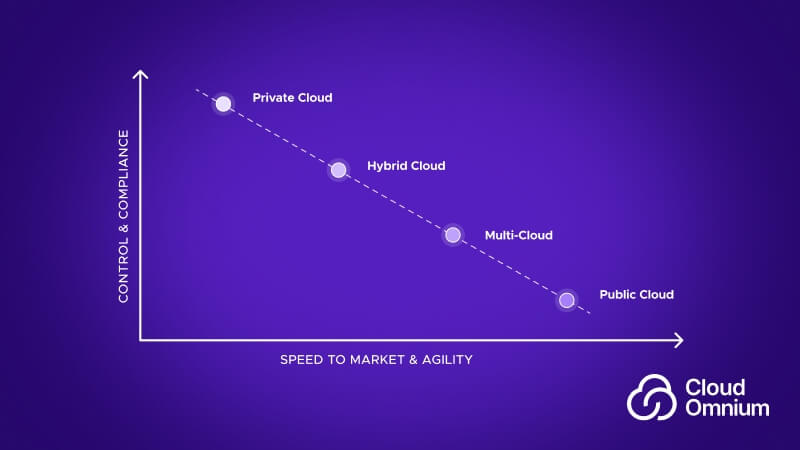
Public cloud turns CapEx into OpEx. That sounds wonderful until your OpEx spikes 200% after an un-optimized BigQuery pipeline runs on a loop over the weekend
Every platform fails eventually. The question is how it fails.
Let’s look at how modern engineering teams actually build these systems to balance safety and elastic scale.
Instead of letting each cloud environment dictate its own set of rules, mature teams build one unified command center above it all. This means leadership manages user access, security compliance, deployment code, and monitoring from a single, centralized layer rather than jumping between separate dashboards. Once that governance baseline is set, your workloads can live wherever they make the most strategic sense—whether running public cloud containers for quick customer reach, dedicated private clusters for protected core systems, or localized setups out at the edge. The real win for leadership is clarity: you keep tight, consistent control over security and costs at the top, while giving engineering the freedom to deploy and scale anywhere without rewriting the rulebook.
In practice, the most reliable setups separate the parts that move fast from the parts that hold your critical data.
Stateless workloads scale rapidly from 10 to 1,000 pods during flash events. Meanwhile, the stateful backends, the transactional databases are housed in optimized private cloud environments or isolated public subnets with pre-allocated IOPS storage volumes. This decouples compute scaling from data persistence, preventing storage lockups during sudden load surges.
Avoid the mistakes that drain enterprise modernization budgets. Mature organizations navigate cloud adoption by following these engineering rules:
Never tie your core business logic to proprietary provider runtimes unless there is an overwhelming business justification. Package applications in standard OCI containers and orchestrate them via vanilla Kubernetes primitives. This keeps your engineering workloads portable, whether they run on local OpenShift clusters or managed EKS.
Do not force your product developers to become cloud network specialists. Build an internal developer platform (IDP) that exposes self-service templates for databases, queues, and container runtimes. Let your central platform team manage the underlying cloud complexity, IAM roles, and VPC peering.
There is no universally “best” cloud. There is only the architecture that matches your current business constraints, regulatory boundaries, and engineering maturity.
For 80% of greenfield applications, a single mature Public Cloud remains the fastest path to market. The velocity gains outweigh the unit-cost premiums.
For large enterprises with heavy compliance requirements, massive steady-state compute volumes, or established data centers, a Hybrid Cloud model built on unified Kubernetes platforms provides the right balance of control, cost governance, and agility.
Multi-Cloud should be adopted with extreme caution. Use it to leverage specific specialized capabilities (such as running machine learning pipelines on GCP while your core CRM lives in Azure), not as a naive failover strategy.
If your organization is evaluating its next move, start here:
Do not make assumptions. Map the actual environment.
Stability? Scale? Containers? Automation? Greater data control?
These are very different projects
Technology without operational capability quickly becomes technical debt.
This question may matter more than the next licensing quote.