Security Information and Event Management (SIEM) Solution
Aggregate and correlate security events across endpoints, networks, and cloud systems to detect and respond to threats as they occur
Why Do You Need a SIEM Solution?
Modern infrastructure generates high-volume, distributed security data across endpoints, cloud workloads, applications, and networks. Without centralized analysis and correlation, critical threats remain undetected or are identified too late. Organizations operating financial systems, SaaS platforms, or multi-tenant environments face specific risks.
A SIEM platform addresses these by aggregating logs across systems, correlating events in real time, and triggering alerts based on defined threat patterns. This allows security teams to detect anomalies as they occur and respond before they escalate into system compromise or data exposure.
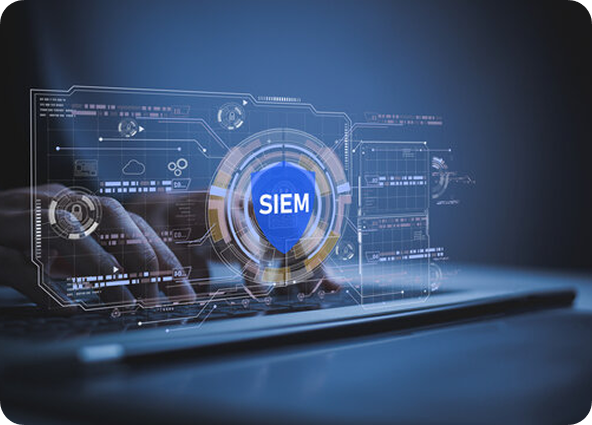

Our SIEM Platform is Built for Real-Time Threat Detection and Control
Cloud Omnium’s SIEM solution is built with distributed ingestion pipelines, a rule-based correlation engine, and indexed storage layers to process and analyze high-volume security events at scale.
Our SIEM platform integrates:
- Wazuh for host-based intrusion detection and log analysis
- Suricata for network-level threat detection
- Threat intelligence feeds including VirusTotal and MISP
- Elasticsearch-based indexing for high-speed search and correlation
Technology Stack of Our SIEM Solution
Powered by leading security and analytics tools for real-time threat detection and response

Filebeat

Elasticsearch

Suricata

Kibana

Wazuh

MISP

VirusTotal

Logstash
Key Features of Cloud Omnium SIEM Solution
Unified security monitoring with intelligent detection, correlation, and compliance-ready visibility
Integration with any kind of Platform
- Integration with security tools, SaaS platforms, and enterprise systems
- Support for Syslog, APIs, and webhooks for system-level connectivity
- Extensible connectors with custom parser support for proprietary platforms
Log Collection & Normalization
- Multi-source log ingestion (endpoints, servers, applications, cloud services)
- Structured parsing and normalization for consistent analysis
- Secure agent-based and agentless collection
Threat Detection & Correlation
- Rule-based detection engine with customizable policies
- Correlation across logs, network events, and system activity
- Detection of anomalies, privilege escalation, and suspicious behavior
Endpoint Security Monitoring
- File integrity monitoring (FIM)
- Configuration assessment and drift detection
- Malware and rootkit detection
Threat Intelligence Integration
- IOC matching using external intelligence feeds
- Enrichment of events with reputation and threat context
- Continuous update of threat indicators
Security Operations & Response
- Real-time alerting with severity classification
- Incident investigation through centralized dashboards
- Automated response actions for predefined threats
Cloud & Workload Security
- Monitoring of cloud environments (compute, storage, APIs)
- Container and workload visibility
- Detection of misconfigurations and abnormal activity
Compliance & Audit Readiness
- Pre-built mappings for standards like PCI-DSS, GDPR
- Centralized audit logs with retention control
- Traceable event history for investigations
Flexible SIEM Deployment Models for Different Operational Requirements
Managed SIEM
Fully operated SIEM with ingestion, detection, and alerting handled by Cloud Omnium.
Dedicated SIEM
Isolated deployment with full control over data storage, retention, and detection rules.
Hybrid SIEM
On-premise log collection with centralized processing and analytics in the cloud.
Built for Regulated and Data-Sensitive Environments




Service Features of Our SIEM Solution
Log Ingestion & Pipeline Monitoring
Monitoring of log ingestion, agent connectivity, and indexing pipeline health across all sources.
Event Correlation & Threat Detection
Real-time log correlation, rule-based detection, and IOC matching across endpoints, network, and cloud data.
Alerting & Incident Escalation
Triggered alerts based on correlation rules with severity mapping and incident escalation workflows.
Benefits of Our SIEM Platform
Faster detection, centralized security operations, and scalable compliance-ready monitoring
High Availability Detection Pipeline
Distributed processing and indexed storage ensure continuous detection during node failure or ingestion spikes.
Scalable Log Ingestion
Horizontally scalable pipelines handle increasing event volume without performance degradation.
Data Residency & Retention Control
Region-based storage and policy-driven retention ensure compliance with regulatory requirements.
Reduced Detection and Response Time
Cross-source correlation enables faster identification and containment of security incidents.
Consolidated Security Operations
Centralizes logging, detection, and alerting to reduce tool fragmentation and operational overhead.
Plan Your SIEM Deployment and Data Strategy
Set ingestion capacity, correlation rules, retention strategy, and deployment model aligned with your security and compliance constraints.

FAQs
What does a SIEM solution actually do?
A SIEM system collects logs from across your infrastructure, correlates events, and identifies potential security threats based on predefined rules and behavioral patterns.
How is SIEM different from XDR?
SIEM focuses on log aggregation and correlation across systems, while XDR extends into endpoint and response capabilities. Modern platforms often combine both.
Can your SIEM handle high log volumes without performance impact?
Yes. Our SIEM platform uses horizontally scalable ingestion and indexing pipelines. They allow event processing capacity to increase as log volume grows without affecting detection performance.
Where is our SIEM data stored and how is residency handled?
Data is stored in region-specific or dedicated infrastructure based on your compliance requirements. You will have full control over storage location and retention policies.
How long does it take to deploy your SIEM solution?
Deployment is completed within days for standard environments. The exact timeline is set based on log source integration and ingestion scope.