
Breaking Vendor Lock-In: The Enterprise Playbook for Open Source Cloud Migration
22 October 2026


For many enterprises, infrastructure decisions that once seemed straightforward are becoming harder to justify. Licensing models change, hardware reaches the end of its lifecycle, infrastructure costs grow, and the systems supporting critical business operations become increasingly difficult to modify. At the same time, organisations need infrastructure that can support faster application delivery, stronger security practices, growing data volumes, and more demanding availability requirements.
Open-source infrastructure offers another way forward. Technologies such as OpenStack, Ceph, Kubernetes, KVM, and infrastructure automation tools enable organisations to build and operate cloud environments with greater control over their architecture. Instead of relying entirely on a proprietary platform, enterprises can assemble infrastructure around open technologies, supported by the operational practices and services their business requires.
But migration is not simply a matter of replacing one technology with another. A successful transition requires a clear understanding of existing workloads, application dependencies, storage requirements, security controls, and operational capabilities. Some workloads may be migrated with minimal changes. Others may need modernisation before they can benefit from a new environment. This guide explains how enterprises can approach open-source cloud migration through a structured, risk-aware process, from initial assessment and architecture design to workload migration and ongoing operations. The objective is not to adopt open source for its own sake. It is to build infrastructure that aligns with business needs today while leaving room for change tomorrow.
Why enterprises are reconsidering their infrastructure strategy
Enterprise infrastructure rarely changes overnight. Banks, telecommunications providers, government organisations, fintech companies, and large service providers often operate environments built over many years. These environments support critical applications, databases, internal platforms, customer services, and business processes. Reliability matters, and replacing a familiar platform can introduce significant operational risk. So why consider migration at all? The answer usually involves several pressures that build over time.
Rising and unpredictable infrastructure costs
Infrastructure costs extend well beyond the initial purchase. Licensing, support contracts, hardware refreshes, storage expansion, upgrades, specialist skills, and operational overhead all contribute to the total cost of ownership. When a platform’s commercial model changes, organisations may need to reassess whether their existing architecture still offers the right value.
Moving to open-source infrastructure can reduce dependence on proprietary licensing. However, it does not eliminate the cost of running a cloud. Hardware, engineering, security, support, maintenance, and disaster recovery still require investment. The more useful question is whether the organisation can achieve a better balance between cost, capability, and operational control.
Vendor dependency and limited flexibility
Vendor lock-in is not only a contractual issue. It can also be an architectural one. Applications may depend on proprietary APIs, storage formats, networking configurations, management tools, or platform-specific automation. Over time, these dependencies can make migration increasingly difficult.
Open-source technologies provide access to their source code and open development ecosystems, subject to their respective licences. Standards-based interfaces and portable automation can also make it easier to integrate or replace individual components.
That flexibility is valuable, but it must be designed into the architecture. An open-source platform can still create operational dependency if it relies on undocumented configurations or expertise held by a single team.
The need for greater infrastructure control
Some organisations need greater control over where their data resides, how access is managed, and how infrastructure is operated. This is particularly relevant for environments with strict security, regulatory, or data-residency requirements.
A private cloud built on open-source technologies can give an organisation greater control over infrastructure placement, network boundaries, identity management, and operational policies. It does not automatically guarantee compliance or security. Those outcomes depend on implementation, governance, monitoring, and ongoing maintenance.
Infrastructure must support faster change
Business applications evolve more quickly than traditional infrastructure procurement cycles. Development teams need environments they can provision consistently. Operations teams need repeatable deployments, reliable monitoring, and predictable recovery procedures. Security teams need visibility into changes and clear accountability for access.
An infrastructure platform that depends heavily on manual configuration can become a bottleneck. Combining cloud platforms with automation, observability, and DevOps practices helps organisations make infrastructure more repeatable and easier to manage.
These pressures lead to a broader strategic question: should an enterprise continue expanding its existing proprietary environment, migrate to public cloud services, adopt open-source infrastructure, or use a combination of these approaches? There is no universal answer. The right decision begins with understanding the workloads and the business requirements behind them.
What does migrating to open-source infrastructure actually mean?
Open-source cloud migration means moving workloads, data, and infrastructure services from an existing environment to a platform built around open-source technologies.
The destination might be a private cloud, a hybrid environment, or a modern container platform. The right choice depends on what the organisation needs to run and how it wants to manage those workloads. A common mistake is to treat open source as a single product. It is better understood as an ecosystem of technologies that work together.
OpenStack: Cloud infrastructure management
OpenStack provides an Infrastructure-as-a-Service platform for managing compute, networking, and storage resources. It enables organisations to build private clouds where teams can provision virtual machines and infrastructure resources through APIs or a dashboard. It is worth evaluating when an enterprise needs a structured private cloud rather than simply a collection of virtualised servers.
Kubernetes: Container orchestration
Kubernetes automates the deployment and management of containerised applications. It is useful for workloads designed around containers, distributed services, and modern application delivery. However, Kubernetes is not a universal replacement for virtualisation. Traditional virtual machines and applications with specific operating-system requirements may need a separate migration strategy.
Ceph: Distributed storage
Ceph provides object, block, and file storage within a unified distributed storage system. It can support virtual machine disks, application data, and object-storage use cases, depending on the architecture. For enterprises managing growing data volumes, it offers a way to build storage capacity around their infrastructure requirements instead of relying exclusively on proprietary storage platforms.
Terraform and Ansible: Infrastructure automation
Automation tools help teams define infrastructure consistently, repeat deployments, and reduce manual configuration. They also make it easier to document and review infrastructure changes. Their value becomes especially clear when environments need to be recreated, expanded, or recovered under pressure.
These technologies serve different purposes. They can complement one another, but an enterprise does not necessarily need all of them. The goal is to select a stack that fits the workload, security requirements, operating model, and available engineering expertise.
Choose the right migration strategy before choosing the platform
Not every application needs the same migration approach. An internal reporting system, a banking transaction platform, and a customer-facing application may have completely different requirements for availability, data consistency, latency, and recovery. A practical migration strategy begins by classifying workloads according to their complexity and business importance.
Strategy 1: Lift and shift
Lift and shift moves a workload to a new infrastructure environment with minimal changes to the application itself. This approach may work well for applications that are compatible with the destination platform and have relatively straightforward dependencies. For example, an enterprise may move an existing virtual machine from a proprietary virtualisation environment to an open-source virtualisation platform while retaining the same operating system and application configuration.
The main advantage is that the application does not need to be redesigned before migration. However, lift and shift does not automatically improve application architecture, performance, or resource utilisation. Those improvements may require further optimisation after the move.
Best suited for: Compatible virtual machines, legacy applications that cannot be redesigned immediately, and workloads where minimising application changes is a priority.
Strategy 2: Re-platform
Re-platforming involves making targeted changes so that an application works more effectively in its new environment. An organisation might migrate an application to a new infrastructure platform while updating its storage configuration, deployment automation, database connectivity, or monitoring.
The application itself remains largely intact, but the supporting environment changes. This approach can help organisations address technical limitations without undertaking a complete application rewrite.
Best suited for: Applications with manageable dependencies, systems that need some modernisation, and organisations seeking a balance between migration risk and long-term improvement.
Strategy 3: Refactor or re-architect
Some applications are too closely tied to their original infrastructure to benefit fully from a straightforward migration. They may rely on proprietary APIs, tightly coupled services, manual deployment processes, or assumptions about storage and networking that no longer apply.
In these cases, the organisation may need to redesign parts of the application, introduce containerisation, separate application components, or adopt new deployment patterns. This can create greater long-term flexibility, but it also requires more engineering effort, testing, and business coordination.
Best suited for: Applications undergoing broader digital transformation, systems with significant architectural constraints, and workloads where the business case supports deeper modernisation.
| Strategy | Application changes | Relative complexity |
|---|---|---|
| Lift and shift | Minimal | Low to moderate |
| Re-platform | Targeted | Moderate |
| Refactor or re-architect | Significant | High |
These are relative planning categories, not fixed estimates. Actual complexity depends on dependencies, data volume, application criticality, and the destination architecture.
A practical framework for enterprise cloud migration
A successful migration is a controlled engineering programme, not a one-time infrastructure deployment. The following six stages provide a practical framework for moving from the existing environment to a production-ready open-source platform.
Stage 1: Discovery and assessment
Identify what exists before deciding what should move. Inventory physical servers, virtual machines, applications, databases, storage, network configurations, licences, and support arrangements. Map dependencies between applications and infrastructure components. Establish a baseline for CPU, memory, storage capacity, network throughput, latency, availability, and current operating costs.
Deliverable: An infrastructure inventory, dependency map, workload classification, and initial risk register.
Stage 2: Architecture and target design
Translate business requirements into an infrastructure design. Select the appropriate compute, networking, storage, identity, backup, monitoring, and automation technologies. Define failure domains, security boundaries, capacity requirements, and disaster recovery objectives. Decide which workloads belong on virtual machines, which should use containers, and which should remain in their existing environment temporarily.
Deliverable: A target architecture, migration roadmap, capacity plan, and security design.
Stage 3: Proof of concept
Test the assumptions before making a large commitment. Select a representative workload and deploy it in the proposed environment. Validate application compatibility, network connectivity, storage performance, identity integration, backup and restore, and operational visibility. The proof of concept should test real business requirements, not just whether a virtual machine can start.
Deliverable: A tested migration pattern, documented limitations, and evidence to support the go/no-go decision.
Stage 4: Validation and optimisation
Confirm that the new environment is ready for production. Test performance under expected and peak loads, failure recovery, security controls, monitoring alerts, backup restoration, and operational procedures. Refine resource allocation and automation based on the results.
Deliverable: Documented test results, resolved critical issues, and production acceptance criteria.
Stage 5: Controlled migration and cutover
Move workloads in planned waves. Begin with lower-risk systems where possible. Synchronise data, confirm application dependencies, validate integrations, and execute the agreed cutover procedure. Maintain a tested rollback plan and clear decision authority throughout the transition.
Deliverable: Migrated workloads with validated functionality, data integrity, and business sign-off.
Stage 6: Operations and continuous improvement
Migration is complete only when the new environment can be operated reliably. Monitor capacity, application performance, security events, storage health, and backup status. Establish patching schedules, incident response, change management, recovery drills, and ownership for ongoing maintenance. Decommission the old environment only after dependencies, retention obligations, and rollback requirements have been addressed.
Deliverable: An operational runbook, monitoring and escalation processes, recovery evidence, and an ongoing optimisation plan.
The key principle is straightforward: each stage should reduce uncertainty before the next stage increases the scale of the change.
What should the target architecture look like?
There is no single open-source architecture that fits every enterprise. The design depends on workload density, availability requirements, regulatory constraints, expected growth, and how much operational complexity the organisation can manage. For many organisations, a private cloud built on OpenStack and Ceph is a useful option to evaluate.
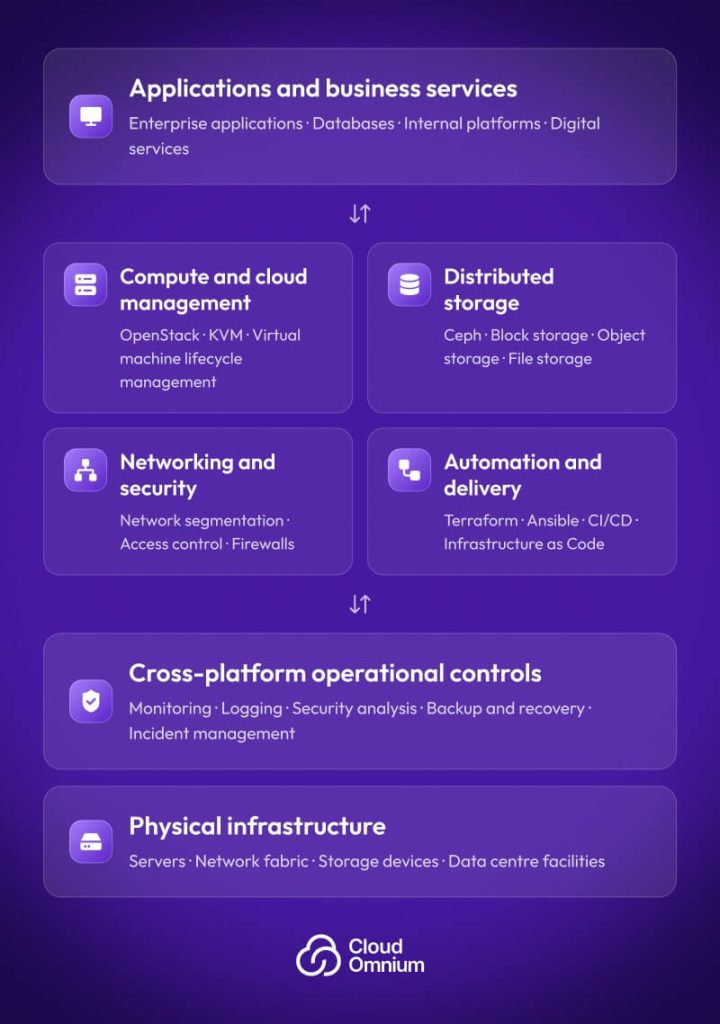
Conceptual architecture for discussion. A production design will vary by workload, availability targets, and selected technologies.
In this model, OpenStack provides cloud resource management, while Ceph supplies distributed storage. Automation helps teams deploy and manage the environment consistently. Monitoring and security controls provide visibility across the stack.
The architecture can also integrate Kubernetes for containerised applications. However, virtual machine infrastructure and container orchestration should be designed according to their respective workloads rather than treated as interchangeable technologies.
OpenStack’s own architecture documentation describes how compute, network, storage, and governance functions can be combined into different deployment topologies. The appropriate topology should follow the organisation’s capacity and resilience requirements.
The migration challenges enterprises should plan for
Open-source technologies can provide considerable flexibility, but changing infrastructure introduces technical and operational challenges that need to be addressed before production cutover.
Application and dependency compatibility
An application may appear to be a straightforward migration candidate until the team discovers dependencies on specific drivers, network behaviour, storage configurations, operating-system versions, or proprietary platform features.
What to do: Document dependencies during discovery, test representative workloads, and validate application functionality in the target environment before migrating dependent systems.
Data integrity and storage performance
Moving virtual machines is only part of the job. Databases, file systems, object storage, and applications with frequent writes may require different migration methods. Large datasets can take considerable time to transfer, while the final synchronisation may affect the cutover window.
What to do: Select a data migration method based on the workload, establish integrity checks, measure transfer and synchronisation times, and test backup restoration before production migration.
Downtime and service continuity
Even a technically successful migration can become a business problem if applications remain unavailable longer than expected. Critical workloads may need phased migration, replication, parallel operation, or a carefully timed cutover.
What to do: Define acceptable downtime and recovery objectives with business stakeholders. Rehearse the cutover, establish rollback conditions, and assign decision-makers before execution.
Security and compliance
Open source does not mean security is automatic. Organisations remain responsible for secure configuration, identity and access management, patching, vulnerability management, audit logging, and appropriate data handling.
What to do: Build security requirements into the target architecture, enforce least-privilege access, monitor infrastructure activity, and validate applicable regulatory and internal control requirements.
Skills and operational readiness
A new platform can introduce unfamiliar tools, interfaces, and troubleshooting methods. If the existing team is not prepared to operate it, the organisation may exchange one dependency for another.
What to do: Plan training, documentation, operational ownership, escalation paths, and support arrangements as part of the migration programme.
A platform should not be considered production-ready simply because it performs well during deployment. It must also be supportable when something goes wrong.
How to measure the business case for migration
A migration proposal should go beyond comparing software licence prices. Open-source infrastructure may reduce some licensing expenses, but the financial outcome depends on the full cost of operating the new environment.
A useful comparison should include the following:
| Cost or value area | What to evaluate |
|---|---|
| Licensing and subscriptions | Existing licence commitments, support fees, and new support costs |
| Hardware and capacity | Reuse of existing servers, refresh requirements, storage, and networking |
| Migration investment | Engineering, tooling, testing, data transfer, and temporary parallel operation |
| Day-to-day operations | Staffing, training, maintenance, monitoring, and incident response |
| Resilience and security | Backup, disaster recovery, security tooling, and compliance work |
| Business impact | Downtime exposure, provisioning speed, flexibility, and service delivery |
The total cost of ownership should be compared over the same planning period and under realistic assumptions.
For example, consider an enterprise whose current virtualisation contract is becoming more expensive. Moving to an open-source private cloud may reduce recurring licensing costs, but the business still needs to fund migration, engineering, support, and ongoing operations.
The business case becomes stronger when it demonstrates how those costs compare with the current environment and what additional capabilities the organisation gains.
Three useful measures are:
- Total cost of ownership (TCO): The complete cost of running each environment over an agreed period.
- Recovery performance: Whether backup restoration and disaster recovery meet business-defined recovery objectives.
- Operational efficiency: Changes in provisioning time, manual effort, deployment consistency, and incident resolution.
The objective is not to promise a universal percentage of savings. It is to establish a credible baseline and measure the actual results.
A real-world lesson: migration requires more than infrastructure
Cloud migration becomes easier to understand when viewed through the lifecycle of a real enterprise application. Cloud Omnium’s Government Resource Planning (GRP) project provides one example. The project involved deploying a government resource planning platform with the Bangladesh Computer Council, using an OpenStack private cloud environment at NDC before supporting its transition towards the NDC e-Gov Cloud platform. The work included infrastructure provisioning, backup, deployment support, and operational processes across multiple application environments.
The lesson is not that every enterprise should use the same architecture.It is that successful migration involves much more than moving servers. Teams must account for application environments, infrastructure dependencies, backup, repeatable deployments, and operational validation. For organisations operating critical digital services, these activities are essential to building confidence in the new environment.
A migration programme should therefore evaluate success at two levels:
- Infrastructure success: The target platform is deployed, workloads run, and resources are available.
- Business service success: Applications behave correctly, data remains consistent, integrations work, and operational teams can support the system.
The second is what ultimately matters to the business.
When should an enterprise begin its open-source migration?
An organisation does not need to wait until its existing infrastructure reaches a breaking point. There are several useful triggers for beginning an assessment:
- A major licensing or support renewal is approaching.
- The current infrastructure is becoming difficult to scale or maintain.
- Data residency or infrastructure control requirements are changing.
- Provisioning and deployment depend too heavily on manual processes.
- The organisation needs stronger backup, disaster recovery, or observability.
- Infrastructure teams are planning a hardware refresh or broader modernisation programme.
The first step does not have to be a full migration. An infrastructure assessment can identify which workloads are suitable for migration, which require additional work, and which should remain where they are for now.
A phased roadmap allows the organisation to establish priorities, validate its assumptions, and build operational confidence before moving its most critical systems.
Open source is a strategic infrastructure decision
Migrating to open-source infrastructure is not simply about replacing proprietary software with freely available alternatives. It is an opportunity to reconsider how infrastructure is designed, operated, secured, and funded.
For some workloads, a straightforward migration will be sufficient. Others will benefit from re-platforming or deeper application modernisation. In every case, the approach should be guided by business requirements, technical evidence, and an honest assessment of operational readiness.
OpenStack can provide the foundation for a private cloud. Ceph can deliver distributed storage. Kubernetes can support containerised workloads, while automation and observability help teams manage change with greater consistency. But the technologies alone do not guarantee a successful outcome. Architecture, migration planning, testing, security, and ongoing operations matter just as much.
At Cloud Omnium, the focus is on helping organisations navigate this transition with a practical understanding of their infrastructure, workloads, and business requirements. From assessment and architecture design to migration execution and managed operations, the aim is to build environments that offer greater control, resilience, and flexibility.
The right time to explore open-source infrastructure is before your existing environment forces you to make a decision. Start by understanding what you have, what needs to change, and what your business expects from the infrastructure that will support its next stage of growth.
Before You Replace VMware, Ask These Five Questions
If your organization is evaluating its next move, start here:
What workloads are we running today?
Do not make assumptions. Map the actual environment.
What do those workloads need tomorrow?
Stability? Scale? Containers? Automation? Greater data control?
Are we replacing a platform or modernizing an operating model?
These are very different projects
Do we have the skills to operate the new environment?
Technology without operational capability quickly becomes technical debt.
How much control do we want over our infrastructure in five years?
This question may matter more than the next licensing quote.