
How Our Team Kept Bangladesh's National Vaccination System Running for 131+ Million People
Project Summary
- Infrastructure Provisioning
- Database Management
- Backup
- L1/ L2/ L3 Support and Troubleshooting
Cloud Platform:
- NDC e-Gov Cloud
- Government / Public Health
- Bangladesh
One Platform. 131 Million+ People. No Room for Error.
2021 was not a good year to have bad infrastructure in the public services sector.
Bangladesh was staring down a global pandemic with a population of over 150 million people and a government under enormous pressure to roll out vaccines as fast as possible. The Prime Minister’s Office and the Directorate General of Health Services were leading the programme, while the Bangladesh Computer Council served as the client. Every ministry that touched public health had a stake in this.
The platform they built to manage it all was called Surokkha. Launched in January 2021, it was the country’s single national system for COVID-19 vaccination management. Citizens used it to register, verify their identities, receive OTPs, get vaccination schedules, have their doses recorded, and verify their vaccination certificates. Everything ran through it, across every district, every vaccination center, every campaign phase for five years.
We came in to own the infrastructure. Not just set it up and hand it over, but run it, maintain it, defend it, and keep it alive through everything the next five years would throw at it.
National Vaccination Platform
What Made This Genuinely Difficult
A lot of systems claim to be high-stakes. Surokkha actually was.
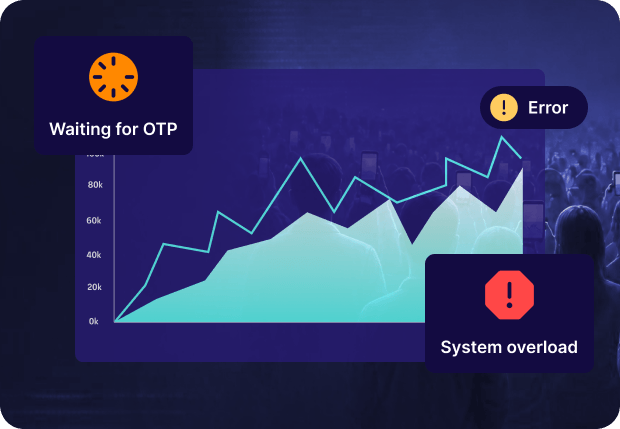
The first problem was speed. There was no gradual ramp-up, no soft launch. When registration opened, the whole country tried to sign up at the same time. Millions of concurrent users, all triggering citizen database lookups, receiving OTPs, all expecting the system to respond in seconds. The infrastructure had to be ready from day one, because the pandemic gave 150 million people no choice but to log on immediately, and no patience to wait for it to catch up.
Then the goalposts moved. Mid-campaign, the eligible population jumped from roughly 0.3 million to 7.5 million, a 24x increase with little warning. Scaling had to happen on the fly. You cannot take a national vaccination system offline to upgrade it while a health crisis is still running.
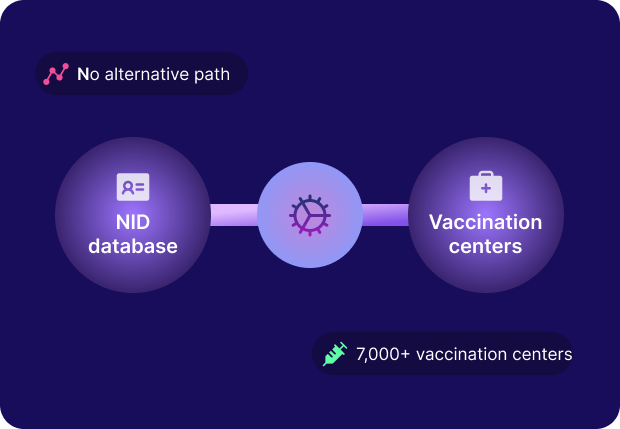
Third-party integrations introduced another layer of risk. Surokkha relied on external systems including the NID database, passport and birth registration records, and SMS providers for identity verification, OTP delivery, and other essential services. These dependencies had to be managed carefully, with failover mechanisms and resilience built in from the outset rather than added later.
Across the country, about 7,000+ vaccination centers were connected to the same system simultaneously. Each center managed its own scheduling, checked citizens’ vaccination cards, and recorded doses, all in real time. That is a lot of concurrent database activity happening in parallel, every day, for the duration of the campaign.
And then there were the attacks. This was not a background concern or a theoretical threat. The State Minister of ICT confirmed publicly that hackers made coordinated attempts to take Surokkha down during active campaign periods. These were targeted, deliberate efforts to disrupt a national health program. The infrastructure had to hold up against them, not eventually, but every single time.
How Our Team Handled It
The Infrastructure Foundation
Everything ran on the NDC e-Gov Cloud, Bangladesh's sovereign national data center infrastructure. That decision mattered beyond just performance. It meant all citizen data, NID & passport records, birth registration information, vaccination histories, stayed entirely within government-controlled systems. For a national health program handling the personal data of 131 million+ people, that was non-negotiable.
HAProxy and NGINX managed load balancing and traffic distribution across the web layer. The combination meant traffic was always being routed intelligently, and no single server was a point of failure, and active and passive health checks were continuously running. When load spikes came, whether from a new campaign announcement or a registration deadline, the system absorbed them without users noticing.
Database Architecture and Tuning
MySQL NDB Cluster was the right call for this workload. It is a distributed database built for high availability and high concurrency, and Surokkha needed both. With millions of records and thousands of simultaneous connections, a standard setup would have created serious bottleneck problems.
Proactive Monitoring and Threat Protection
Prometheus and Grafana gave the team a continuous view of infrastructure health, resource utilization, and performance across the stack. The ELK Stack brought all the logs together in one place so that when something needed to be investigated, engineers were not digging through disconnected systems.
The security posture was hardened at both the infrastructure level and the database component level. Strong security controls protected the platform from potential threats and unauthorized access. The platform stayed online. Citizen data stayed protected. The vaccination program kept running.
More than twenty engineers held the operation together for the full five years, L1 handling frontline monitoring and first response, L2 managing deeper technical issues, L3 for complex infrastructure and database-level problems. There was always someone watching.
The Result
Aimed to meet the WHO’s global target of vaccinating 70% of the population.
Zero
Data breaches across five years
In Client’s Words
Security and Compliance
Every record held by Surokkha was sensitive – from NID numbers, birth registration records, and passport data to individual vaccination histories. For five years, the platform managed the data of more than 131 million people, requiring robust infrastructure and rigorous security safeguards.
All of it stayed on the NDC e-Gov Cloud, within sovereign government infrastructure. Prometheus, Grafana, and the ELK Stack maintained continuous visibility into what was happening across the stack. Hardening at the infrastructure and component levels, while implementing and maintaining a Web Application Firewall (WAF), meant the defenses were real, not just on paper.
Modernize Public Services with Secure Government Cloud Solutions
Let your agency serve citizens while Cloud Omnium keeps infrastructure sovereign, secure, and audit-ready.